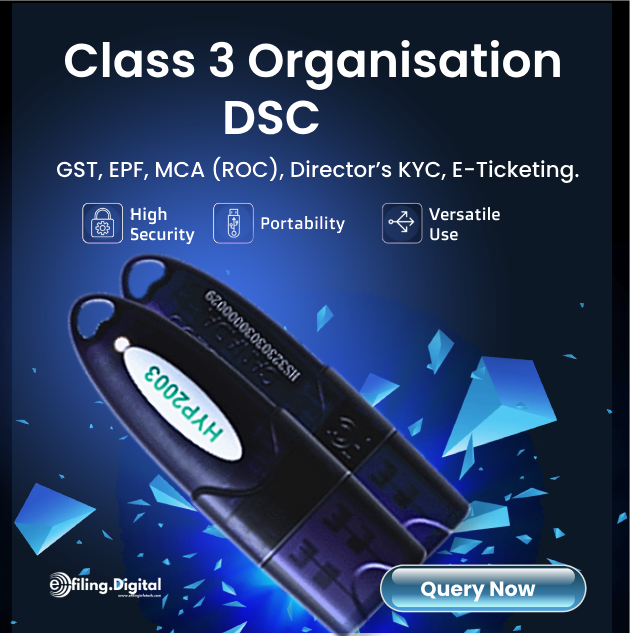
Not every business needs a Digital Signature Certificate to register for GST — but some can't complete registration without one. Here's exactly where your business stands, and how to get compliant fast.
What Is a DSC, in Plain Terms
A Digital Signature Certificate (DSC) is the electronic equivalent of your handwritten signature. It's issued by a government-licensed Certifying Authority and lets an authorized signatory sign documents on the GST portal in a way the law recognizes as legally valid.
At eFilingInfotech, we issue and register Digital Signature Certificates for GST, income tax, and MCA filings every day, and the question we hear most often isn't "how do I use a DSC" — it's "do I even need one?" That's the part most guides skip. Here's the direct answer.
Who Needs DSC Mandatorily
For three types of entities, DSC isn't optional. The GST portal simply won't accept any other authentication method from them.
Companies
Private limited, public limited, and one-person companies (OPCs) must sign their GST registration application and returns using a DSC.
LLPs & Foreign LLPs
Domestic LLPs and Foreign LLPs (FLLPs) registered in India face the same requirement — no EVC alternative is offered.
Foreign Companies
Foreign companies operating and registering in India must also authenticate GST filings with a valid DSC.
Who Can Skip DSC
If you fall into one of these categories, you can complete GST registration and filing using Aadhaar-based OTP verification instead:
- Proprietorships — register and file using your Aadhaar number and EVC, no DSC needed unless you want the extra layer of authentication.
- Partnership firms (not LLPs) — can authenticate using EVC or Aadhaar e-sign.
- Individuals and HUFs — same flexibility, verified via OTP to your registered mobile number.
DSC vs. E-Sign vs. EVC: What's the Difference
Businesses researching this topic usually run into three terms on the GST portal and assume they're interchangeable. They're not.
| Method | How it works | Who uses it |
|---|---|---|
| DSC | USB token-based digital certificate, signed via the emSigner utility | Companies, LLPs, Foreign Companies (mandatory) |
| E-Sign | Aadhaar-linked OTP signs the document electronically | Individuals, proprietors, partners with Aadhaar |
| EVC | OTP sent to the authorized signatory's registered mobile number | All non-mandatory entity types |
Getting a DSC for GST: What You Need to Know
- Get a Class 3 DSC. The GST portal now accepts only Class 3 certificates for most filings — Class 2 is being phased out across regulatory platforms.
- Use a licensed Certifying Authority. Your DSC must come from a government-authorized CA. eFilingInfotech's GST registration service includes DSC issuance and portal registration as part of the same process, so you're not chasing two vendors.
- Match your PAN exactly. The DSC must be registered under the same PAN as the authorized signatory listed in your GST application. This single mismatch is the most common cause of registration rejection — check it before you submit.
- Register it on the GST portal. Log in, go to Register/Update DSC, select the authorized signatory's PAN, run the emSigner utility, and complete the signing step.
Quick Reference
| Entity Type | DSC Required? | Alternative |
|---|---|---|
| Company (Pvt Ltd, Public, OPC) | Yes, mandatory | None |
| LLP / Foreign LLP | Yes, mandatory | None |
| Foreign company | Yes, mandatory | None |
| Proprietorship | No | Aadhaar E-Sign / EVC |
| Partnership firm | No | Aadhaar E-Sign / EVC |
| Individual / HUF | No | Aadhaar E-Sign / EVC |
Frequently Asked Questions
Is DSC mandatory for GST registration for every business?
Can I use a Class 2 DSC for GST filing?
Why does the GST portal reject my registered DSC?
Can a proprietor choose to use a DSC anyway?
Not sure which category your business falls into?
eFilingInfotech handles DSC issuance, PAN matching, and GST portal registration end to end — so you're not stuck troubleshooting rejections on your own.
Get Your DSC for GST Today